Sunday, 17 April 2011

Post 7- The Paradox of Choice

With the advent of the music streaming services such as Spotify, Last.fm and Grooveshark, it has become possible to access millions of tracks within seconds. On paper, these services would appear to be a great tool for music discovery as you can flit seamlessly between any number of songs. However it is often the case that I'll open Spotify and find I'm unable to commit to choosing music to listen to simply because of the sheer number of options.

When I brought up this point at a group tutorial it seemed that others also experienced this inability to choose. We are not alone either, I wanted to look deeper into whether the number of available options has an effect on our decision making abilities generally and, on Googling 'too much choice' I found that a discourse had been opened which posits that it does. 

The key proponent of this idea is psychologist Barry Schwartz, whose book The Paradox of Choice: Why More is Less describes how an abundance of choice in almost all aspects of western, consumer societies has led to more anxiety about our choices, and a hesitancy to make them for fear that we will regret our decision and dwell on what may have happened had we made a different choice.

He sums his theory up in this TED talk, citing some pretty compelling evidence and personal anecdotes that I found pretty relatable. You may choose to watch it....

Post 6- Rule Sketches


Post 5- Eclectism

The flaws that make stats based music recommendation systems so skewed and limited made me start to consider what, if anything, exists to help people genuinely discover new music. On reflection, one of the richest veins of new music I have come across is Gideon Coe's BBC 6music show. Gid's shows are a marked by a playlist of tracks from a complete myriad of genres and time periods (it's not unusual to hear metal, reggae, folk and swing represented in a single show) framed by the friendly, relaxed atmosphere created by the presenter's affability and dry humour.

I'm sure it is no coincidence that I find more new music through listening to this show than anywhere else (from genres and time periods that, left to my own devices, I would never consider exploring) and that the show is delivered in such a mellow, disarming manner. This, I think, makes the audience generally more receptive to the unfamiliar sounds thus allowing for the genuine discovery of new music, as opposed to finding artists that are unreliably branded as 'related' to one you already like.

Perhaps the aim of my project should not be finding the best way to help people find new music they like, perhaps it is to help facilitate a change of attitude to the kind of open-minded, non-judgemental one which Gideon Coe's shows manage to evoke that make it possible to derive pleasure from listening to almost anything.

Give the show a listen here, or tune in to 6 music from 9-12pm on weeknights, it's an especially good show to get you through those work sessions where midnight oil may be burned. 

Post 4- Visual Brainstorming

Some of the ideas conceived during the ideas generation process included using data to create an illustrated landscape or a creature/organism and looking at the idea of the data building a structure alluding snowflakes and minerals. Whilst the former were maybe too gimmicky and had strong connotations inherent to them, the latter ideas of looking at structures that occur in nature merited a little more experimentation and it was these that I had in mind in doing my first visual tests.    


Post 3- Music Recommendation Systems

After realising the limitations that are inherent in any music recommendation system, a refocusing of the project was needed. Why did I want to create a visual music recommendation system in the first place? 

The simple answer was that I often got bored of my music or drew a blank when I opened Spotify, wanted to find new, exciting stuff to listen to and found that most of the things that are designed to help do this were pretty unhelpful.

They would often throw up some odd, tenuously linked artist to the one I had started out from. A case in point are the band Biffy Clyro who I have followed from their 2nd album in 2004. They have cited their influences as being from grunge and prog-rock and have been subject to comparisons to artists such as Nirvana, The Pixies, Rush and Fugazi who also used to be among their 'related artists' on Spotify. After their most recent and most popular album though, Nirvana etc have been supplanted by the artists that their new, bigger mainstream fanbase also listen to, so they are now supposedly 'related' to Florence and The Machine, Mumford and Sons and Plan B.

These comparisons say little about the music itself, they are determined by factors like how the band is marketed, which magazines and radio shows feature them and which type of listener takes ownership of them. Thus, unless you are the type of listener who conspicuously consumes music to identify yourself with the groups that are moulded by marketing, these features are not of much use.   

Post 2- Essay- Growing Trend for Flexibility in Visual Identities

Back in January, I wrote an investigative essay on visual identities broaching the subject of the contemporary shift away from the more traditional form of static identity design in favour of more flexible approaches which encompass visual systems, generative design principles and the creation of distinctive visual languages.

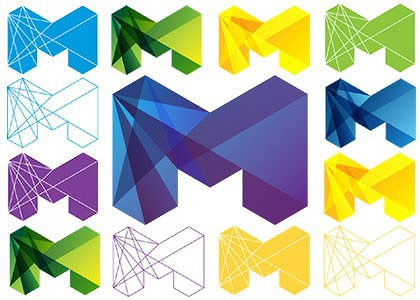
It discusses these points with reference to case studies on the London 2012 logo and Landor's dynamic identity for the city of Melbourne (below) and can be seen as a kind of precursor to, or foundation for the work in this project.


Post 1- Original Concept.

The original brief I set myself was to create a music recommendation system that was fully visualised. I envisaged a set of visual symbols that would be created by the very music that they represented through a generative visual system taking in various aspects of data from it. You would then be able to get an intuitive, immediate overview of different pieces of music and compare or relate those to others. 

In contrast to the majority of recommendation systems that base their recommendations on dominant listening trends and patterns, (such as Amazon and Spotify)  this system would be rooted in the actual sound properties of a piece of music and so would be closer to Pandora, though less comprehensive (Pandora aggregates 400 characteristics for each song) and more indicative.

However, at the point where I started to actually break music down into data and translate this into visuals, I realised just how reductive this process was and, crucially, how no amount of quantitative data (not even 400 characteristics per song) would be able to define an atmosphere, sentiment or meaningfully pre-empt the subjective, esoteric intangible that is personal taste. As a friend summarised neatly in a conversation about my idea, we don't like music because it has X beats per minute- "its just a whim".